DRIFT’s Aeolus translates a room’s architecture into suspended glass curves, while responsive lighting lets visitors set its visual rhythm.
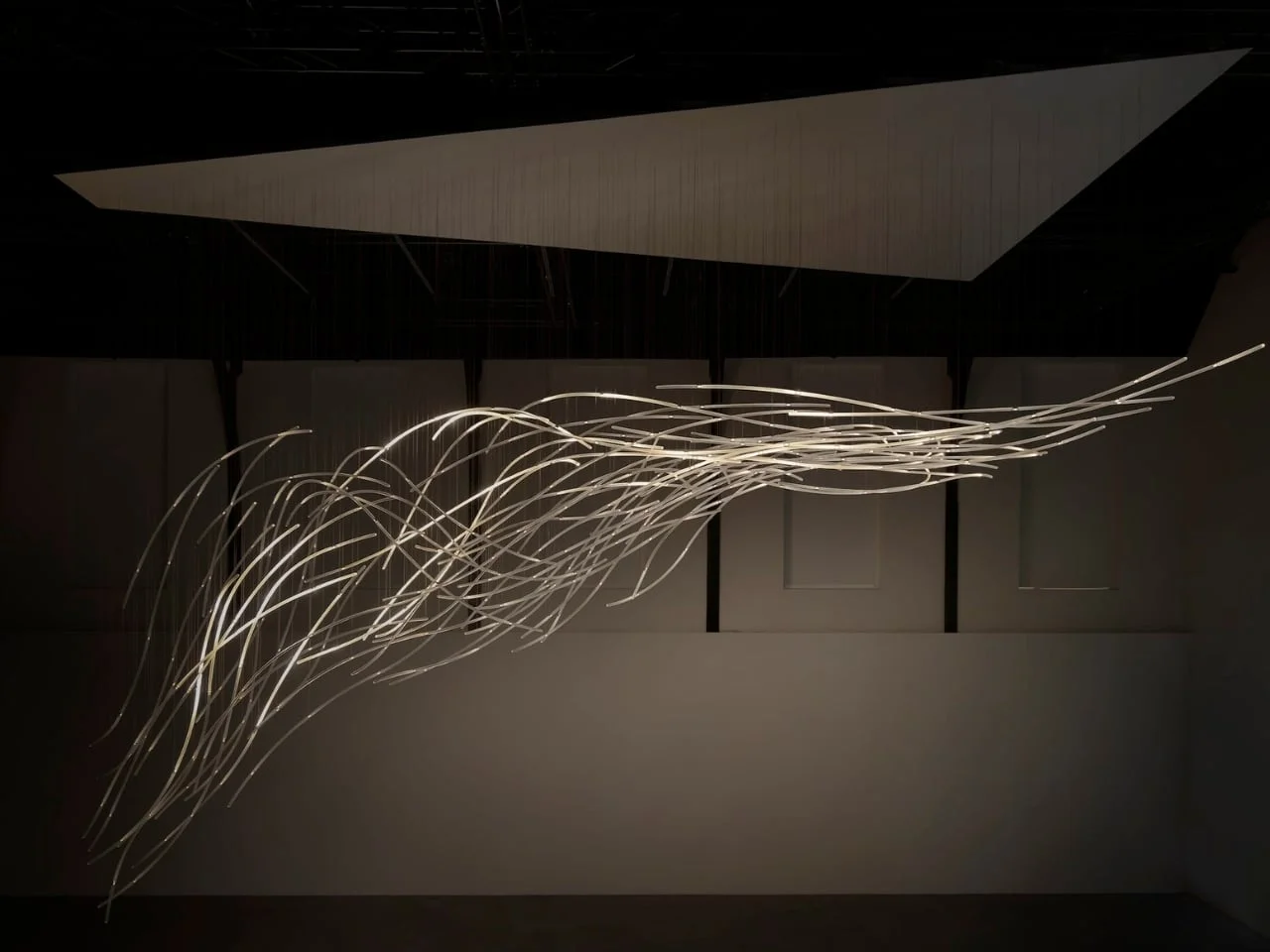
Aeolus makes wind visible by holding it still. The installation by Amsterdam studio DRIFT turns a simulated flow of air into hundreds of suspended glass rods, then uses responsive light to suggest motion across the fixed structure. Its central idea is simple and effective: a sculpture doesn’t need to move to make visitors feel movement.
Founders Lonneke Gordijn and Ralph Nauta developed the work for Carpenters, which will present it at London’s Ladbroke Hall from October 13 through 25, 2026. Named for the Greek god of the winds, Aeolus takes its form from the architecture around it. That gives the installation a site-specific logic: the room helps determine the sculpture’s shape instead of serving as a neutral backdrop.
There’s a useful tension here. Wind is usually understood through its effects—bent branches, rippling water, a shift in temperature—because the air itself can’t be seen. DRIFT gives that invisible force a durable outline, then uses light and visitor movement to keep the outline from feeling entirely static.
Designer: DRIFT
A building becomes part of the design
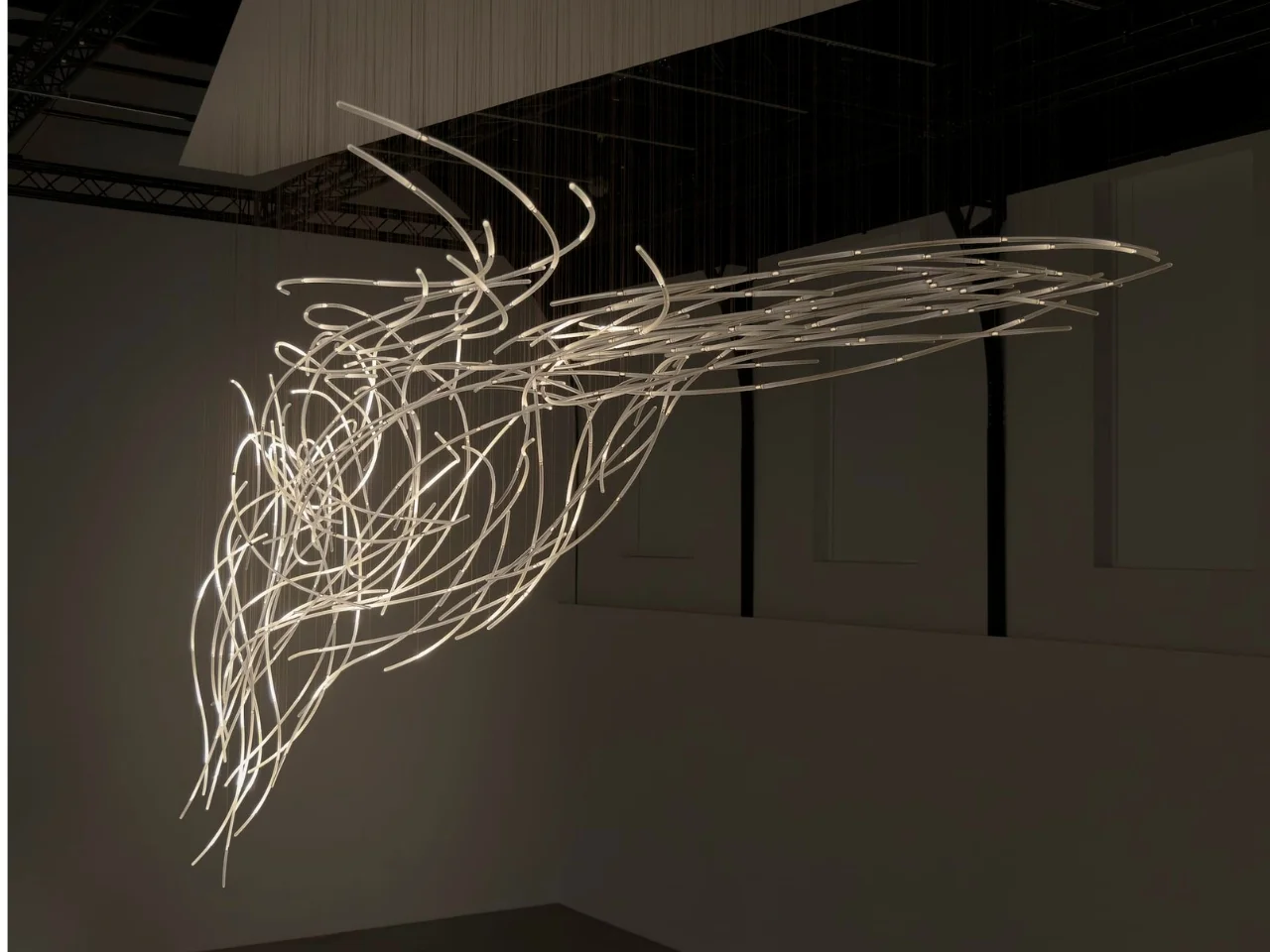
DRIFT starts by digitally mapping the host architecture and recreating it as a virtual environment. The studio then simulates airflow through that model, selects a moment from the resulting movement, and translates it into glass. Aeolus records a designed interpretation of air moving through a particular space; it isn’t a live display of conditions in the gallery.
That distinction matters. A live airflow display would respond to changing conditions in the room, while Aeolus turns a simulation into a lasting form. The result is closer to a sculptural snapshot than a weather instrument: it gives visitors a way to inspect a modeled path after the movement that inspired it has been fixed in glass.
Rather than placing a finished object inside a room, DRIFT derives the sculpture from the room itself. The digital model stays behind the scenes, but its influence appears in the curves. Each installation is generated from the architecture that houses it, making the building an active part of the design process.
This approach also sets a clear limit on what the work represents. It offers an interpretation of airflow shaped by a model and a selected moment, not a literal record of every current passing through the gallery. That’s a sensible tradeoff for a sculpture: the simulation provides a form that can be built and seen, while the resulting object remains legible as an artwork.
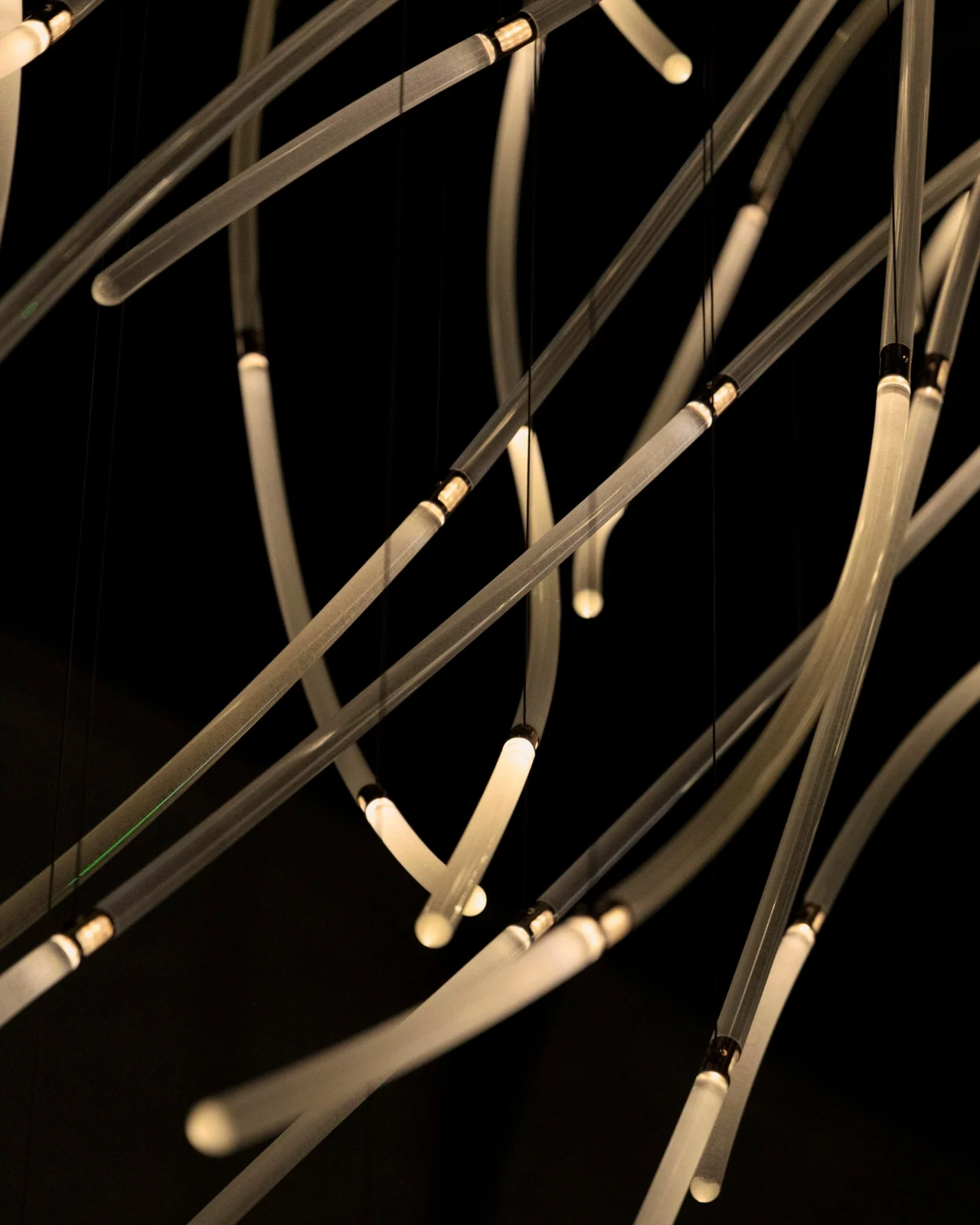
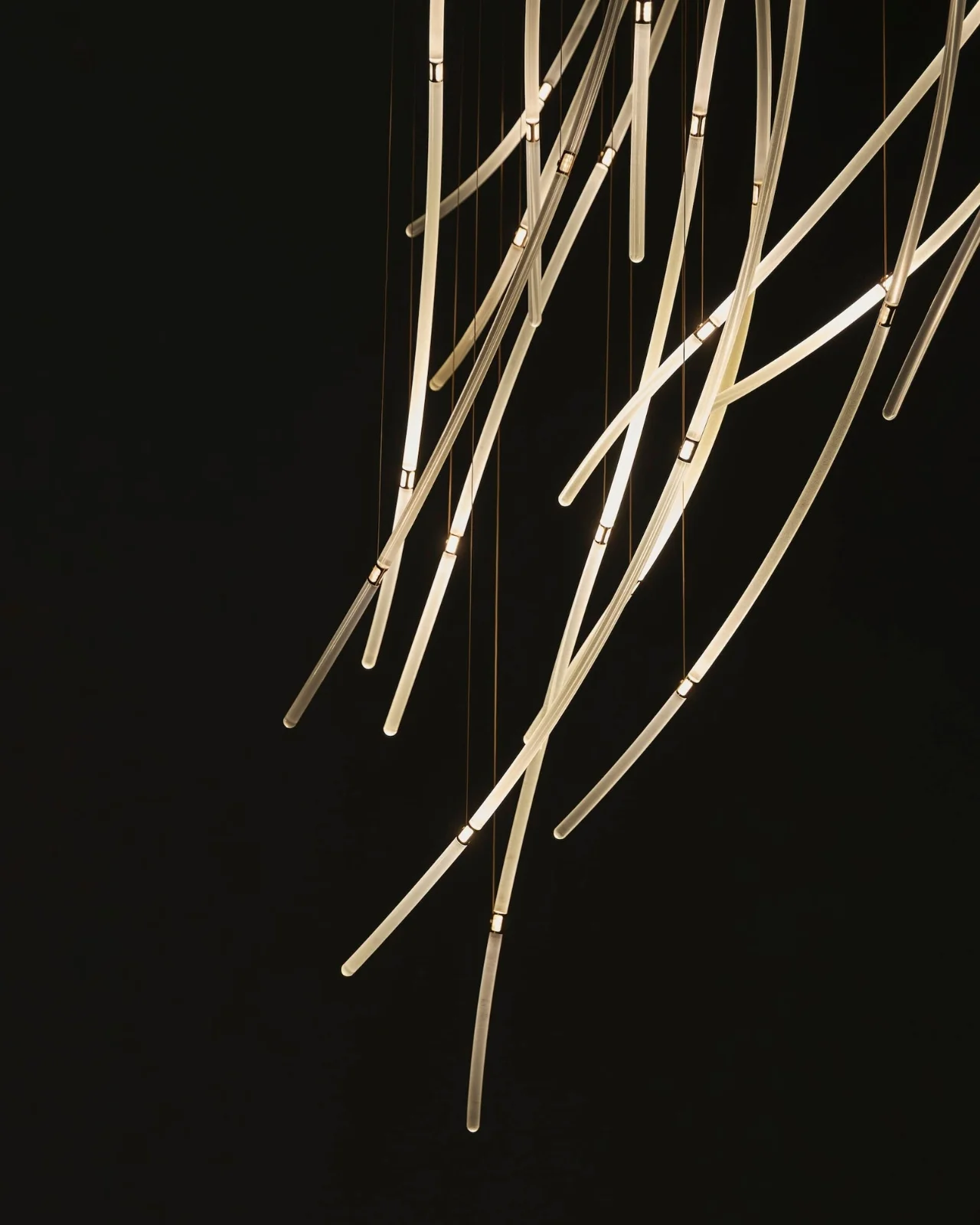
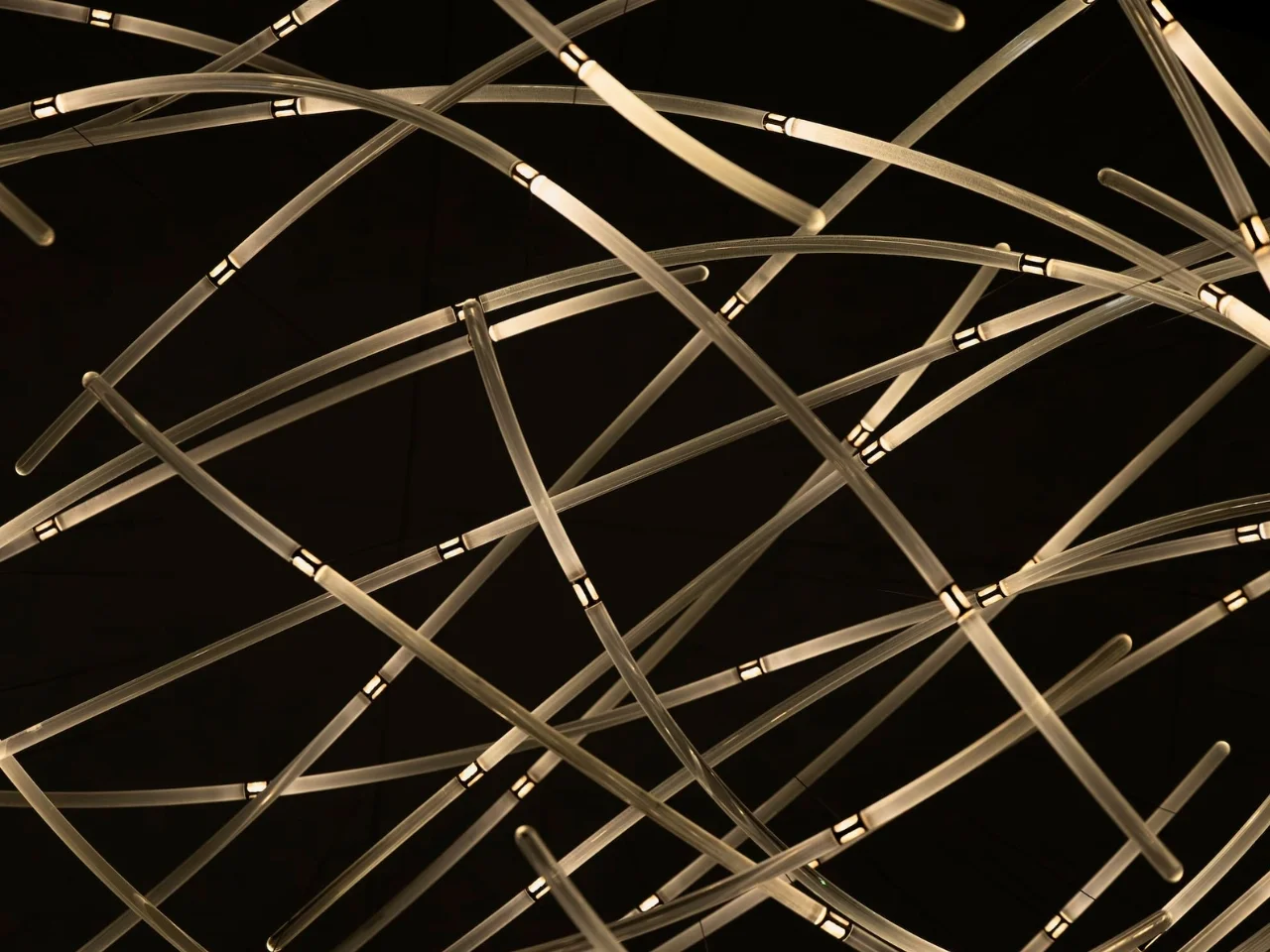
Photographs by Benjamin Baccarani show the rods forming a long, sweeping shape, with one end dipping as the structure reaches outward. Fine suspension lines connect it to a broad overhead panel. The silhouette looks light, but producing it depends on a precise assembly of borosilicate glass rods, stainless steel nodes, custom LEDs and microcoax cables.
The materials make the engineering behind the airy outline easy to overlook, and that’s part of the piece’s appeal. The glass has to read as a coherent path rather than a collection of separate components; the support system has to hold the form while remaining visually quiet. This is more significant than it looks: the illusion of weightless motion depends on careful physical construction.
Light gives the fixed sculpture a pulse
The rods don’t sway. Carpenters says small lights inside them change rhythm and intensity as visitors move through the space. Shifting illumination travels across the glass, suggesting motion without moving the sculpture itself. The work stays physically composed while its appearance takes on a changing tempo.
That choice makes light do more than illuminate the object. It becomes the main way the sculpture changes in response to its surroundings, offering movement as a shift in emphasis and rhythm rather than as mechanical motion. The effect relies on visitors noticing those changes, so the work rewards time spent watching instead of a quick pass through the room.
Visitors influence the installation simply by walking. They aren’t asked to operate a control panel or learn a separate interface; their movement produces a visible response. Here’s the thing: that restraint suits a piece about air, which people usually experience indirectly. The interaction feels connected to the subject rather than added as a separate feature.
(And this is the part most people overlook.) A responsive installation can make the visitor feel like a participant, but the response here remains quiet and indirect. You move; the light changes; the glass seems to carry that change along its length. No instructions are needed. Just a shift in attention.
What the work asks of its audience
DRIFT presents Aeolus as an invitation to reconsider our relationship with nature. The more tangible achievement is its focused translation of an invisible force into material and light. Viewers can follow a path that simulated airflow might take, then watch their own movement alter the way that path appears.
That framing has limits. A sculpture built from a simulation can make an abstract process easier to consider, but it can’t stand in for the full experience of weather or the complexity of natural systems. Aeolus works best when read as an interpretation: a composed image of motion that makes a familiar but unseen phenomenon available for close attention.
That shift also changes how the room reads. It becomes more than a container for an artwork: its architecture shapes the form, while visitors add a changing visual rhythm. The building supplies the conditions for the sculpture, and people supply some of its visible variation. If you’re working in this space, the useful question is how much interaction a work needs before it starts distracting from its central idea. Aeolus keeps that answer restrained.
Why the approach matters
Aeolus points to a broader design possibility: digital simulation can shape a physical artwork without making the technology the main event. The model informs the form, but visitors encounter glass, light and the architecture around them. That balance is persuasive because the technical process has a visible consequence while remaining in the background.
There’s also a practical challenge in the site-specific method. A form derived from one building’s architecture may not transfer unchanged to another, which means the work’s identity depends partly on where it’s installed. That can deepen the relationship between artwork and venue, though it also makes each presentation less like a repeatable object and more like a response to a particular room.
Aeolus turns a fleeting idea of airflow into something that can be examined at leisure. The glass holds one imagined instant; the lights and the people moving beneath it keep that instant alive. The numbers here are underwhelming in one sense: the piece can’t show the full complexity of moving air. Its strength lies elsewhere, in making a small, legible portion of that complexity visible.
The post DRIFT’s Glass Sculpture Traces Wind Without Moving first appeared on Yanko Design.


Discussion
Sign in to join the discussion.